Introduction
As industries in Pakistan navigate a fast-changing world marked by rapid expansion and environmental pressures; moreover, the need for clean and safe water has become paramount; therefore, an industrial RO plant emerges as a vital asset in providing high-quality water for manufacturing, processing, and cooling systems. With escalating water scarcity projected to affect over 80 million people by 2025 according to recent reports; furthermore, outdated infrastructure and pollution exacerbate the crisis, making advanced purification essential. However, reverse osmosis technology addresses these challenges effectively; consequently, offering up to 99% contaminant removal for sustainable operations. In addition, sectors like textiles and pharmaceuticals increasingly rely on these systems; as a result, boosting efficiency and compliance. At WaterZone, a leading provider of water purification solutions, we specialize in state-of-the-art industrial reverse osmosis plants customized to diverse needs; thus, delivering superior performance, durability, and comprehensive nationwide support.
Understanding the Basics of Industrial RO Plants
To comprehend the fundamentals; first, an industrial RO plant is a large-scale facility utilizing reverse osmosis technology to eliminate impurities, dissolved salts, bacteria, and contaminants from water; for instance, by forcing it through a semi-permeable membrane that permits only pure molecules to pass. However, unlike conventional filtration; moreover, RO excels in handling high volumes, often thousands of liters per hour, ideal for demanding industrial applications. In addition, WaterZone designs these plants with integrated pre- and post-treatment for optimal results; consequently, meeting stringent quality standards in Pakistan’s variable water conditions. Furthermore, the efficiency of an industrial reverse osmosis plant hinges on factors like raw water quality, membrane selection, and system configuration; as a result, providing cost-effective, sustainable solutions amid the country’s growing market for purifiers, valued at USD 513.32 million in 2024 and projected to reach USD 812.91 million by 2030 at a CAGR of 9.43%.
How Does an Industrial RO Plant Work? A Step-by-Step Process
To illustrate the operation; first, the industrial RO plant process starts with raw water intake from sources like rivers or municipal supplies; then, pre-treatment removes sediments and chemicals to protect membranes; next, high-pressure pumps drive the water through RO membranes for core purification; and finally, post-treatment refines the output for use. However, WaterZone optimizes this with automated controls; moreover, aligning with 2025 trends in energy efficiency. In addition, the complete industrial RO plant process may include remineralization for balanced water; consequently, suiting sensitive industries. Furthermore, in Pakistan’s context of industrial growth; as a result, these steps ensure compliance and reduce downtime, supporting the sector’s projected advancements in water treatment technologies.
Industrial RO Plant Working – Core Components and Their Functions
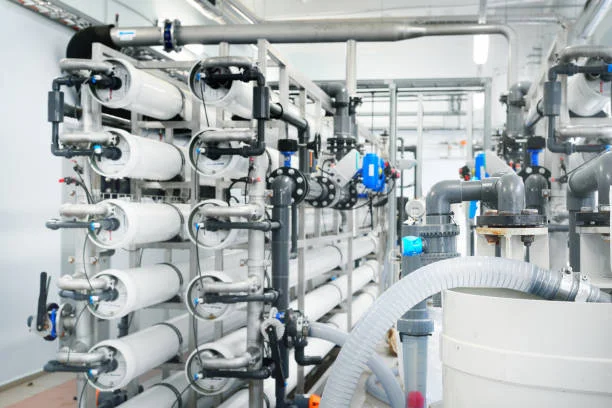
The industrial RO plant working relies on interconnected components for seamless purification; for instance, pre-treatment systems like sediment and carbon filters eliminate initial contaminants; then, high-pressure pumps generate the required force; next, RO membranes serve as the primary barrier against dissolved solids; and finally, post-treatment units like UV sterilizers ensure ultimate quality. However, WaterZone enhances these with smart sensors for real-time monitoring; moreover, incorporating 2025 innovations in membrane durability. In addition, robust piping and controls support high-capacity operations; consequently, minimizing failures. Furthermore, each element is engineered for Pakistan’s harsh environments; as a result, extending lifespan and efficiency.
For a clear overview; in summary, here’s a table of core components:
| Component | Function | Benefits in Industrial Use |
| Pre-Treatment Systems | Removes sediments, chlorine, and organics | Protects membranes, reduces fouling |
| High-Pressure Pumps | Generates force for membrane passage | Ensures efficient flow in large-scale ops |
| RO Membranes | Blocks dissolved solids and contaminants | Achieves 99% purity for process water |
| Post-Treatment Units | Sterilizes and adjusts pH/minerals | Delivers compliant, balanced output |
| Control Panels | Monitors and automates operations | Minimizes downtime, optimizes energy |
Industrial Water Filtration and Softening – Enhancing Quality
Beyond basic RO; moreover, an industrial water filtration plant adds layers for superior purity; for example, integrating multimedia and ultrafiltration to handle particulates; therefore, preparing water for effective RO. However, hard water remains a challenge; in addition, an industrial water softener plant uses ion exchange to remove calcium and magnesium, preventing scaling in equipment. Consequently, this combination boosts system longevity; furthermore, reducing maintenance in sectors like textiles. WaterZone’s integrated solutions ensure gentle water on machinery; as a result, enhancing efficiency amid Pakistan’s hard water prevalence.
Waste Water Treatment – A Sustainable Approach
As sustainability gains priority; moreover, waste water treatment solutions are essential in industrial RO plants; for instance, recycling RO reject water through advanced bioreactors; therefore, achieving near-zero discharge. However, processes involve chemical neutralization and further filtration; in addition, enabling reuse. Furthermore, in Pakistan’s scarcity-hit landscape; consequently, these methods conserve resources, aligning with 2025 environmental goals. WaterZone’s systems promote water recycling; as a result, minimizing wastage and supporting eco-responsible operations.
The Future of Industrial RO Plants: 2025 Trends and Advancements
Looking forward; moreover, industrial RO plants are advancing with 2025 trends like AI-driven monitoring and energy-efficient membranes, reducing costs by up to 30%; therefore, enhancing viability. However, hybrid integrations with ultrafiltration are rising; in addition, improving recovery rates to 90%. Furthermore, solar-powered variants address energy issues; consequently, suiting remote sites. WaterZone pioneers these; as a result, preparing industries for a sustainable future.
Why Choose WaterZone for Industrial RO Plants?
When opting for a provider; first, WaterZone stands out with tailored industrial reverse osmosis plants meeting specific needs; therefore, ensuring cost-effectiveness. However, our expertise surpasses others; moreover, with robust designs and nationwide maintenance. In addition, we prioritize sustainability via integrated waste water treatment; consequently, aiding compliance. Furthermore, unlike competitors; as a result, WaterZone delivers unmatched innovation and support for long-term success.
Conclusion
In today’s dynamic industrial environment; moreover, an industrial RO plant is crucial for pure water; therefore, grasping the industrial RO plant working, process, and synergies with filtration, softening, and waste water treatment is key. However, with 2025 advancements emphasizing efficiency; consequently, these systems drive sustainability. WaterZone provides top-tier solutions; as a result, ensuring your operations excel with reliable, eco-friendly water. Thus, connect with us today to customize your plant and advance toward a cleaner future.